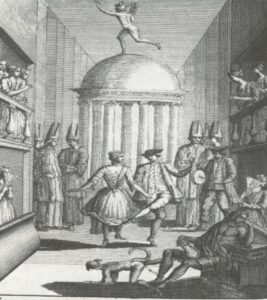
“Wooden Shoe” dancing was popular on the restoration stage from about 1710 and continued to be performed until the early 1800’s. It relationship to clog dancing in the sense which we understand it today is unclear, however it was a fairly popular form of etre’acte entertainment. It was but one of a long list of dances used for this purpose, some of which such as the Jockey Dance survived as a dancing school dance until the 1960s. Others such as the Running Footman have vanished into obscurity.
These entertainments arose initially as a direct result of the way in which scenic changes were made in Restoration theatre. Typically, after a prologue, the curtain would part revealing the scenery required for the beginning of the first act of the drama. As the play progressed the scenery would be physically moved to reveal other scenes behind. A bare stage would indicate the end of an act. In the very early days the gap punctuating acts would ahvbe been short but companies soon came up with the idea of using the bare stage to present entre-acte entertainments to amuse the audience between scenes. Typically a song or dance. The Wooden Shoe Dance was one such entertainment.
Francois Nivelon & Madame Laguerre
We know quite a lot about the performers but virtually nothing about the dance. All the dancers were highly trained professionals, many having studied either in France or with French masters. Their style mush have reflected their training, and they would surely have used the outturned foot and leg positions which are assicuated with other dances of the period.
The best known exponent of the Wooden Shoe Dance was Francois Nivelon, a dancer from the Paris Opera who arrived in London in 1723.
The dance continued to be used at London Theatres until about 1790 and also appear in provincial theatres during the same period.